
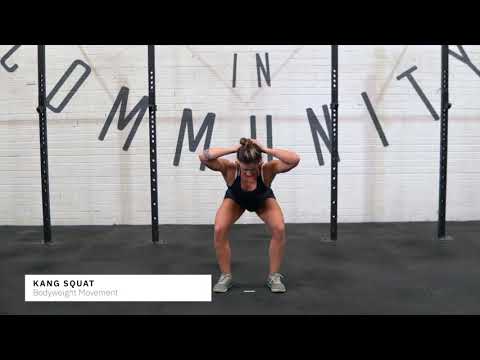
Kang Squat
How to do the kang squat, what it works, the kit you need and the cues that keep the reps honest.
Muscles worked
Primary: Hamstrings. Also works: Glutes, Quads, Lower Back.
Equipment
Bodyweight · Mobility.
How to do it
- 1
Stand with feet shoulder-width apart, hands behind your head or crossed on your chest.
- 2
Hinge at the hips into a good morning, keeping a flat back and soft knees until you feel the hamstrings stretch.
- 3
From the hinge, bend the knees and sink your hips straight down into a deep squat, chest tall.
- 4
Drive the hips back up to return to the hinged good-morning position.
- 5
Squeeze the glutes to stand tall. That is one rep.
Coaching cues
- Keep the spine neutral through every position
- Move slowly — this is a patterning drill, not a strength set
- Only squat as deep as you can keep heels down
Sets, reps and progression
Train the kang squat in a rep range rather than at a fixed number: three to four sets, stopping one or two reps short of failure. When you hit the top of the range on every set, add load next session — that is double progression, and it is the simplest progression model that keeps working.
In Pulse, the working weight is calculated from your current estimated one-rep max for this movement and trimmed automatically on days when your readiness check-in says you are under- recovered, so a bad night's sleep changes the numbers instead of ruining the session.
Keep browsing
Alternatives and related movements
- Alternating Hamstring Curl · Bodyweight
- Alternating Hamstring Curl With Punch · Bodyweight
- Alternating Leg Downward Dog · Bodyweight
- Basic Toe Touch · Bodyweight
- Bodyweight Lying Leg Curl · Bodyweight
- Bodyweight Single Leg Deadlift · Bodyweight
- Butt Kick With Row · Bodyweight
- Butt Kicks · Bodyweight
- Assisted Prone Hamstring · Functional
- B-Stance Dumbbell Romanian Deadlift · Dumbbell
- Band Stiff Leg Deadlift · Bands
- Band Straight Back Stiff Leg Deadlift · Bands
Cite or link to this page
Coaches, physiotherapists and fitness writers are welcome to reference this exercise guide.
Pulse. (2026). Kang Squat: How to, muscles worked and form cues. Pulse Exercise Library. https://pulsecoach.online/exercises/kang-squat
Train it, log it, beat it
Add the kang squat to a program that tracks your loads, suggests the next weight and adjusts to how recovered you are.
Create your free accountTraining guidance only — not medical advice. See our terms.