
Sled Pull
How to do the sled pull, what it works, the kit you need and the cues that keep the reps honest.
Muscles worked
Primary: Hamstrings. Also works: Glutes, Lower Back.
Equipment
sled · Conditioning.
How to do it
- 1
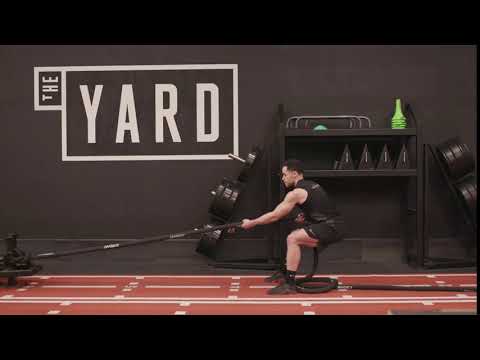
Attach a strap to the sled, face the load, and grip the handles with arms extended while sitting back into a quarter squat.
- 2
Keep your chest high, shoulders back, and core braced firmly before initiating movement.
- 3
Take deliberate backward steps, driving through your heels to pull the sled across the floor.
- 4
Maintain a constant low stance and continuous tension on the straps as you travel backward.
- 5
Stop at the target line, allow the straps to go slack, and stand up to end the set.
Coaching cues
- Maintain a rigid, hinged torso with a neutral spine throughout the backward march.
- Drive backward through your entire foot rather than walking up on your toes.
- Keep your arms fully locked out so your legs and glutes do the heavy work.
Sets, reps and progression
Train the sled pull in a rep range rather than at a fixed number: three to four sets, stopping one or two reps short of failure. When you hit the top of the range on every set, add load next session — that is double progression, and it is the simplest progression model that keeps working.
In Pulse, the working weight is calculated from your current estimated one-rep max for this movement and trimmed automatically on days when your readiness check-in says you are under- recovered, so a bad night's sleep changes the numbers instead of ruining the session.
Keep browsing
Alternatives and related movements
- Alternating Hamstring Curl · Bodyweight
- Alternating Hamstring Curl With Punch · Bodyweight
- Alternating Leg Downward Dog · Bodyweight
- Assisted Prone Hamstring · Functional
- B-Stance Dumbbell Romanian Deadlift · Dumbbell
- Band Stiff Leg Deadlift · Bands
- Band Straight Back Stiff Leg Deadlift · Bands
- Barbell One Arm Side Deadlift · Barbell
- Barbell Romanian Deadlift · Barbell
- Barbell Seated Good Morning · Barbell
- Barbell Staggered Deadlift · Barbell
- Barbell Stiff Leg Deadlift · Barbell
Cite or link to this page
Coaches, physiotherapists and fitness writers are welcome to reference this exercise guide.
Pulse. (2026). Sled Pull: How to, muscles worked and form cues. Pulse Exercise Library. https://pulsecoach.online/exercises/sled-pull
Train it, log it, beat it
Add the sled pull to a program that tracks your loads, suggests the next weight and adjusts to how recovered you are.
Create your free accountTraining guidance only — not medical advice. See our terms.